


It’s quite a time for neurodiversity here in the United Kingdom. As I wrote about last week, Dame Uta Frith’s comments about narrowing the autism spectrum and her opinion that beloved autistic UK naturalist Chris Packham might not be autistic have started a firestorm that continues to be reported on.
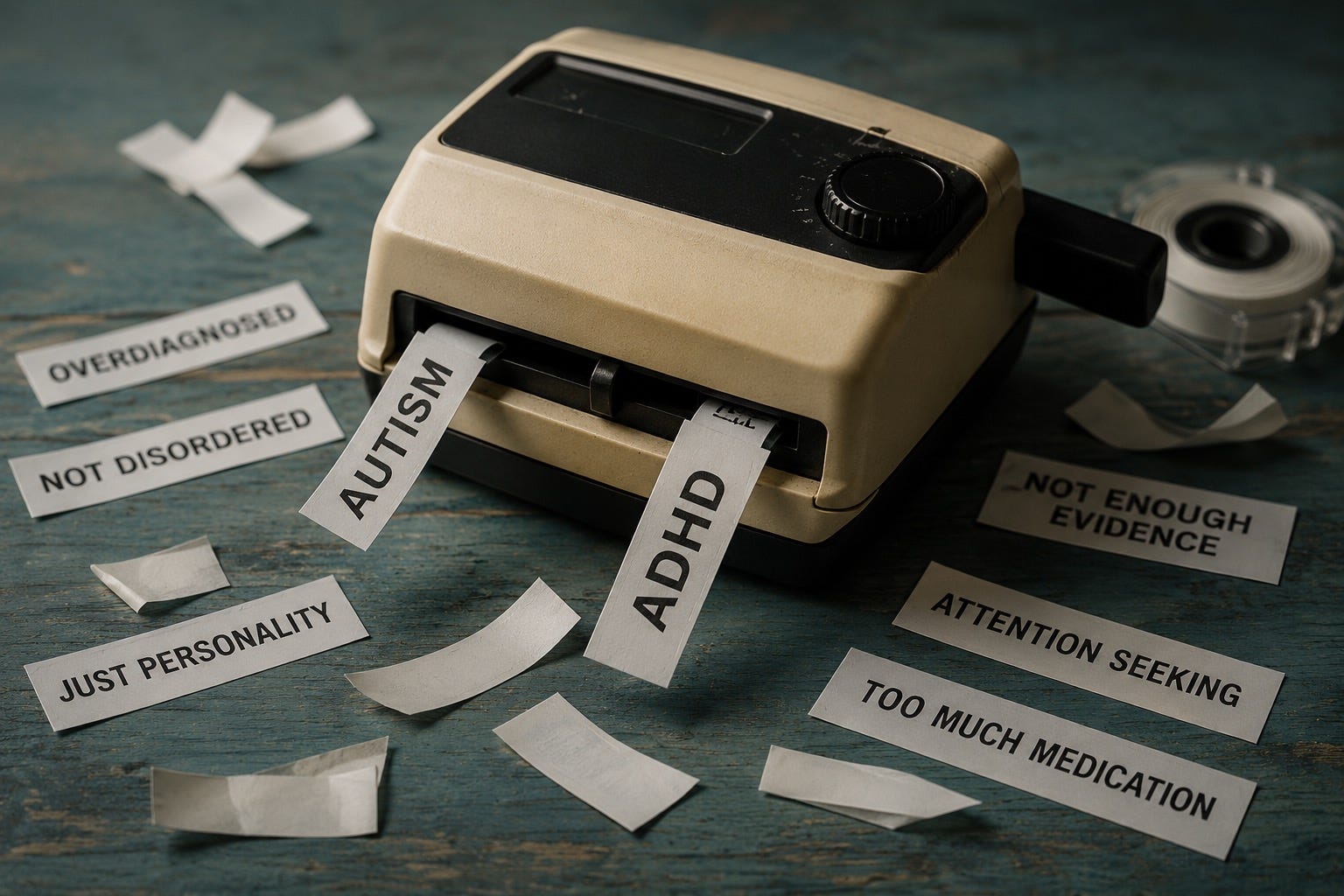
Last week we got a controversial (and in my view, highly flawed) documentary on Channel 4 called “The Great ADHD Myth?.” In this film, Dr. Max Pemberton of the UK National Health Service weaves a tale that makes the case that ALL (not just some) of ADHD is a myth. By the end of the film, Pemberton states that “I’m now convinced it is a myth, that ADHD is not a neurodevelopment disorder.” Pemberton concludes that ADHD is over diagnosed (and I guess shouldn’t be diagnosed at all since it’s not a disorder) and that there’s insufficient scientific evidence to persuade him otherwise. “I think it’s a difficult set of behaviors, a social construct, not a disorder of the brain,” he says. (More on why all of this is flawed below.)
Parallels with what Uta Frith is saying
There are a lot of commonalities between what Frith and Pemberton is saying. Before I go through them, it’s important to point out up front that Frith is not saying that autism is purely a social construct, as Pemberton is saying about ADHD. As I explained last week, Frith wants to reserve the word “autism” for those with visible challenges, particularly in communication, but she very much sees the folks she classifies as autistic as having a medical disorder. But to people with less visible autistic traits who still have an autism diagnosis or identify as autistic, Frith’s comments lead to the same place: we have autistic traits that are part of human difference but (according to Frith) not identifiable as a disability and certainly not as a medicalized disorder. (As I explained last week, Frith says she would have diagnosed me with Asperger’s in the 1990s, but not now.)
I know at least part of Pemberton’s argument resonated with Frith because she brought it up in our conversation. In the documentary, Pemberton decides to get evaluated for ADHD himself by hiring a private doctor for £1200. The doctor concludes that Pemberton has ADHD, which Pemberton tries to paint as a scam - the doctor gets money and the patient gets the diagnosis they wanted. When I suggested to Frith that one of the reasons that self-diagnosis of autism was prevalent was because people couldn’t get seen for a diagnosis or for one that they can afford, she brought up the scene from the documentary.
Frith: Yes. Actually, I was a bit disturbed because in that program, [The Great ADHD Myth?], where the psychiatrist who presented got himself officially diagnosed from a good site—it cost him $1,200.
Me: Right. So, do you have empathy for somebody who thinks they might be autistic, but who can’t get anyone qualified to tell them one way or the other, and then makes a choice? How do we deal with that problem?
Frith: I would tend to say they should really find out for themselves whether they need that validation, or whether they have enough evidence for themselves to be satisfied with it. I would say that they would not get much out of a diagnosis, probably, because people do it very superficially, especially private providers.
This idea of conflicts of interest in autism is very much on her mind. She told the BBC that she questions whether autistic researchers doing research on autism can be objective because they (we) have a conflict of interest. Not surprisingly, this was not well received among autistic researchers. In the same article, Simon Baron-Cohen — who trained with Frith as a graduate student — said she was an outlier in her view. “Someone who’s got a degree in molecular biology has one kind of expertise,” he said, “but someone who’s got lived experience has got another kind.”
I asked her about physician-scientists who take care of children with high support needs but who also see autism as a spectrum that includes those of us who have what she would have diagnosed as Asperger’s in the 1990s. I would say this is the majority of experts that I have talked to.
Me: “I talk to a lot of clinicians who take care of kids who have a lot of impairment. But when I talk to them about people like myself, they are accommodating [of] the idea that lots of people are autistic.”
Uta: “Wouldn’t they have a conflict of interest?”
She said that before I got my question out. I gave her a chance to clarify, but initially she doubled down.
Me: “I guess my question for you is, do you think they’re doing that because they don’t want to deal with the backlash of disagreeing with it? Or do you think that they—”
Uta: “They say the more, the better.”
(I was going to say do you think they actually agree that autism is a spectrum.)
Uta: “That’s a natural tendency, perfectly understandable. If you are assessing, if you are in the professional business, you want customers, don’t you?”
You: “The more the better. You think that’s the whole thing?”
Uta: “Yeah.”
Later in the conversation, Frith tried to soften it by saying “I don’t want to push the commercial motive too much, but I think it’s there.”
the game of deciding whether someone is entitled to a disability label has consumed the conversation of how to get support to the people who need it
So, it’s no surprise that Pemberton’s portrayal of an ADHD industry resonated with her. And it gets to the point that the game of deciding whether someone is entitled to a disability label has consumed the conversation of how to get support to the people who need it. And I certainly do not think that the clinicians I’ve met in my travels are embracing the spectrum because it’s good for their pocketbooks.
The problems with “The Great ADHD Myth?”
The documentary was more of an infomercial on Pemberton’s view rather than journalism. The first problem is that all of the experts interviewed appear to support the thesis that ADHD is not a neurodevelopment disorder. That is certainly not the consensus among ADHD clinicians as these statements from ADHD UK or the Royal College of Psychiatrists show.
Most of the experts in the documentary do agree with Pemberton, but one - Katya Rubia — thought she was there to provide the counterargument only to find her comments used selectively to support Pemberton’s view. Rubia has since withdrawn her support for the documentary, and as quoted in The Guardian:
“I agreed to take part in this documentary because I knew it was aiming to show ADHD was a myth and I wanted to provide an alternative view,” she said. “But they cherrypicked, largely misrepresented, truncated and presented my comments out of context to make them fit into their narrative.
Even a positive review in The Times (of London) noted that “there was no real counter-argument offered to the idea of ADHD as a ‘myth’.”
The anecdotal outcome that argues most strongly against the film’s thesis is relegated to a title card.
The film also relied heavily on a dramatic but unscientific portrayal of a 10-year-old boy, Mason, who we see taken off of his ADHD medication. He felt more ‘himself’ when he was taken off, but his school work deteriorated. The dramatic part was the family’s wrestling with whether to put him back on or not. The film appears to end with the family happy with the decision to take him off his medication only to have a title card at the end saying because his schoolwork had continued to deteriorate, they made the decision to put him back on his medicine. The anecdotal outcome that argues most strongly against the film’s thesis is relegated to a title card.
They have one child used as a study. While this might make for compelling television, it doesn’t prove anything scientifically. As Rubia said in The Guardian:
“This ‘experiment’ provided nothing but anecdotical evidence confounded by a host of factors,” she said. “The child was not only taken off medication, but also off screens, off additives and junk food, subjected to more nature experience and by implication to more interaction with family, friends and parents.
“This can lead to greater happiness and stronger family bonds (for every child, not just ADHD children). There was also the uncontrolled placebo effect of being treated on TV.”
Imagine having a child on medication who is doing well and watching this. It only increases the stigma of ADHD and the decision to use medicine that has been shown to be safe and effective.
Why increasing stigma will only lead to more suffering
I agree with Pemberton and Frith that the traits of ADHD and autism are present in much of the population and - for some of us - create a difference that may or may not rise to the level of disability. Whether traits are disabling is a product both of the traits and the environment. If that environment stigmatizes those traits or a person’s response to them, it will only make those traits more disabling, not less. Increasing stigma is not going to erase the traits of ADHD or autism. In fact, it may cause more people to seek a diagnosis for validation and support, and cause others who need support to fail to access services that could make their lives better.
Anthropologist Richard Grinker, in his book Nobody’s Normal, explains that stigma is cultural and shows how mental health plays out differently in cultures where there is more or less stigma.
“The problem with stigma,” he says, “is not just that society can shame, humiliate, marginalize, discriminate against somebody that doesn't conform to a particular norm. But that we can do it to ourselves; we internalize this idea of what is good and bad, and we can stigmatize ourselves, [which is] incredibly dangerous to one's mental health.”
We absolutely should continue to have scientific debates about how to define ADHD, autism, and many other aspects of neurodiversity and neurodevelopment disabilities. But we need to do so with more compassion and carefully chosen words.
The boundaries might be uncertain, but the consequences are not. Let’s focus on what people need rather than running a contest over who deserves a label more.