


Today I’m posting an interview on the Science Podcast channel (go sign up here!) with Neil Shubin, the new president of the National Academy of Sciences. Shubin is a great choice to lead the NAS at this tough moment: He’s a professor of paleontology at the University of Chicago who has excelled both as a researcher and in science communication. I also learned in my conversation with him that he’s not afraid to answer the tough questions with clarity and conviction.
Shubin published an editorial with us in July where he stated clearly the principles he plans to follow as NAS president:
As an institution, we are — by charter and design and history — nonpartisan. But we are in a deeply partisan age. Just by doing our work, we will be viewed in a partisan light no matter what. So our job is to double down on the science. We need to be a trusted source of data.
By its charter, the Academy is nonpartisan and neither a progressive organization nor a conservative one. It is a scientific body that follows the evidence wherever it leads, even when the destination might be unwelcome. In heated and polarized discourse, it is the Academy’s obligation to be the most careful and trustworthy voice. But rigorous science that arrives too late, or speaks too quietly, serves no one. In this rapidly moving landscape comes the need to move with ever greater speed and reach.
In our conversation, I read these passages back to him, and we used these principles as a touchstone throughout our conversation. He did well at that, going back to these ideas on almost every question. I asked him about how he plans to engage members more, bring younger researchers into the work of the NAS, deal with the complications of AI, and walk the tightrope between when science is just the results and when it has policy implications.
Here’s our conversation:
Shubin’s decision and process to review a controversial chapter
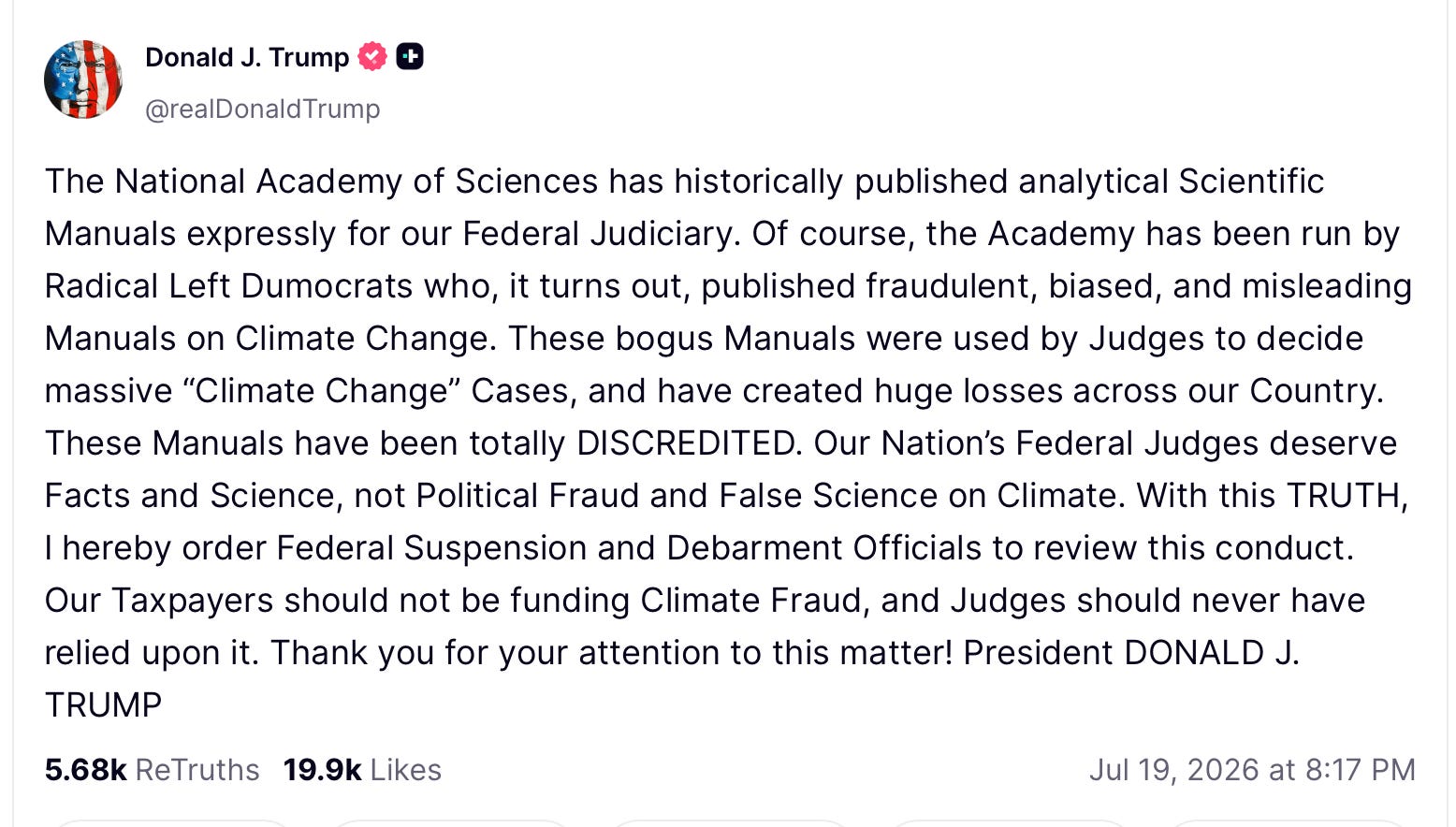
The newsiest part of our conversation was when I asked Shubin about a controversial chapter on climate change in a report that the NAS does for judges. The report is called The Reference Manual on Scientific Evidence, and the NAS prepares it along with the Federal Judicial Center. It’s important to note that a report like this is a compilation of materials, not something that is peer-reviewed according to NAS policies for consensus studies.
President Donald Trump criticized the chapter’s objectivity on social media:
A month ago, the NAS announced they would be reviewing the process by which the chapter was included, citing the fact that the Federal Judicial Center had already decided to remove it from the report:
The National Academy of Sciences was founded on the enduring principle that our nation deserves the best available scientific knowledge. Our core mission is to deploy science in service to the nation while employing procedures that are rigorous, nonpartisan, and that manage potential bias and conflicts of interest. When questions arise whether that standard has been met, we have an obligation to examine them honestly and act on what we find.
The fourth edition of the Reference Manual on Scientific Evidence, produced in partnership with the Federal Judicial Center (FJC), included a chapter on climate science. That chapter has received considerable scrutiny, and the FJC has removed it. The NAS has determined that questions about the processes used to develop the chapter warrant an independent review, and the chapter will not appear on our website while that review is underway.
This assessment is about the process used to produce the chapter and not about the validity of climate science. The focus is on our own procedures and whether they were adequate to ensure the highest standard of objectivity that this institution requires and our nation deserves.
In our conversation, Shubin acknowledges that it was his decision and was “really hard.” I agreed with the decision, because he has now inherited it, and if he is going to defend it in a high-stakes way, he deserves the opportunity to study the process and make sure he wants to stand behind it. He raised the fact that he has been criticized for this. “You can say … that’s appeasement,” he said. “You’re giving in ’cause you’re getting pressure.” I would submit that it is too early to conclude that until he has had a chance to review the decision to include it.
“There’s a lot we don’t know about the process behind it,” he said about the inclusion of the chapter, “but we know the outcome was perceived, and for some in good reason, because the authors were associated more with the plaintiff side than with the defense side, [that] that outcome deserves a new, fresh look.”
Putting it on the credit card
I told Neil that when I was in a job where I had to make these kinds of decisions, we called a move like this “putting it on the credit card.” You take a breather to review the situation, but you also sign up for 18% interest while you deliberate.
Shubin left me convinced he would study it carefully and stand behind his decision.
“I have no doubt,” I told him, “that you’ll pay your credit card bill when it comes due.”
Watch the interview and see if you agree.
Very good. Thanks.
I documented some of the problems with the chapter here:
https://rogerpielkejr.substack.com/p/who-actually-wrote-the-climate-manual
Looking forward to watching this interview. It is definitely a change point for science in the US. Lots of major issues and disruptive technologies. We need good leadership in these times!!