

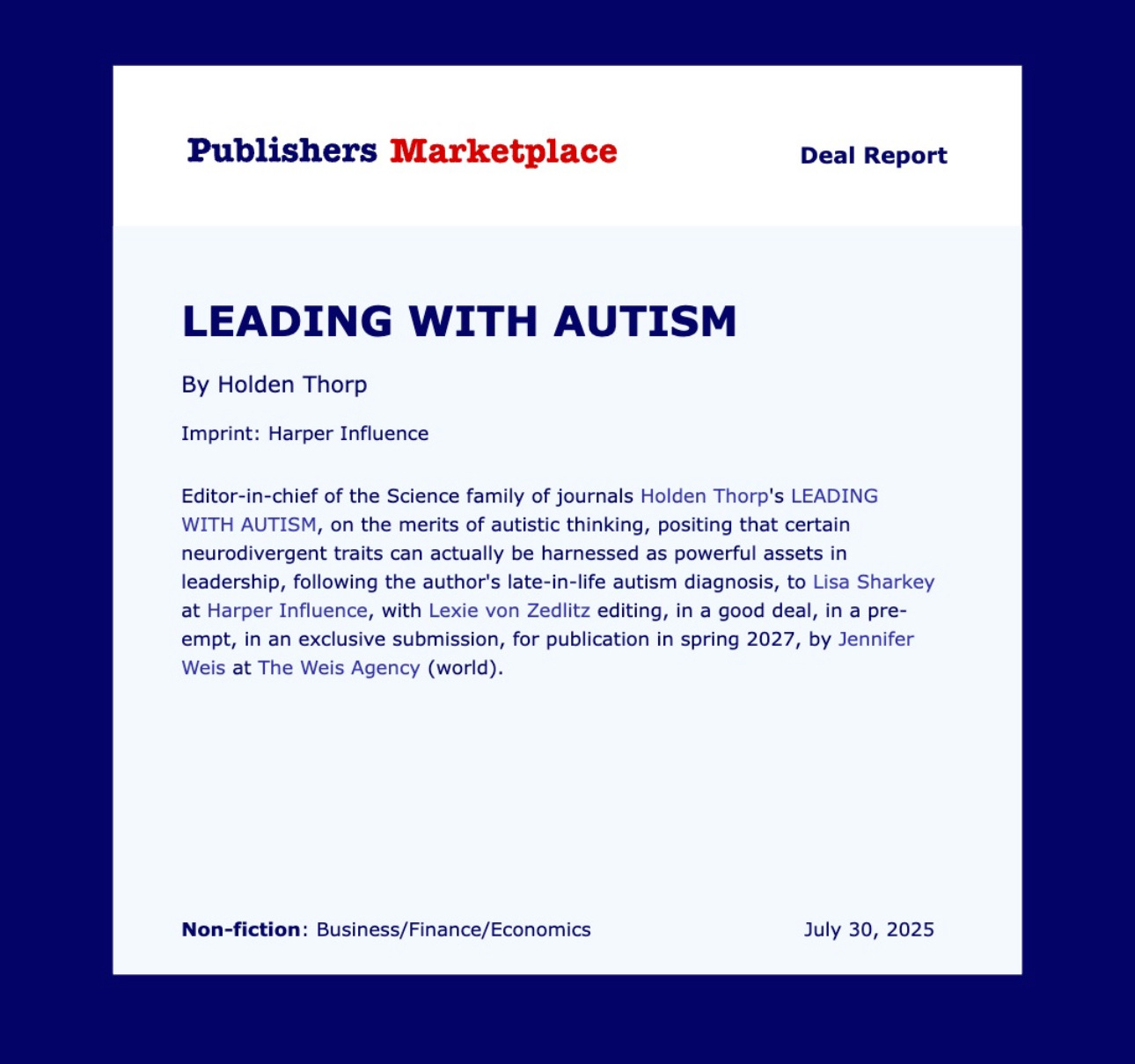
My followers on here have been hearing about my journey with my autism diagnosis from its initial disclosure, to some of the amazing people I have talked to, to my thoughts on why there is no autism epidemic. Over the two years I’ve been working on this, I started talking with the amazing Lisa Sharkey at HarperCollins who runs the Harper Influence imprint about doing a book about this. She introduced me to Jennifer Weis who is a terrific agent who helped me craft a proposal for a book called Leading with Autism that the folks at Harper just acquired. Here’s the announcement on Publisher’s Marketplace:
There’s no shortage of books on autism. There’s excellent memoirs like Look Me in the Eye by John Elder Robison, histories like Neurotribes, books about the impact of culture on autism like Nobody’s Normal, and books about the science by leaders like Simon Baron-Cohen and Temple Grandin. But as I’ve heard from people who have reached out, there aren’t as many books that can (relatively quickly) take you through the history and science of autism, explain the questions and controversies that exist within the autism world, and provide some tips and stories that will help you manage some of the challenges that autistic folks face, particularly those of us leading in our workplaces, families, and social groups.
The goal of Leading with Autism will be to function as the first book a person would read after thinking or hearing from someone else that they might be on the spectrum. This information, as it did with me, tends to hit with a lot of questions. Am I really autistic? What criteria say I qualify? What happened to Asperger’s Syndrome? Does this mean I’m like Rain Man? Why can’t I multiply big numbers in my head? Should I get a diagnosis? Can I? Should I disclose it? If I do, won’t people think I’m just making excuses for myself? Does this mean I need to make TikToks about being autistic? How should I feel about medical research into understanding and even curing autism? Am I part of this autism epidemic I keep hearing about? Do I jump around like Elon Musk?
There are many more. But I wanted to do something that doesn’t require a decision by the reader to go down a particular path of being a self-advocate, deciding they are not autistic, or anything else. I’ll say where I come down on these for myself, but hopefully give people information that will allow them (and their loved ones) to think about where they fit in.
Therefore, the unusual thing about the book is that the chapters are organized not historically or according to a particular rubric of autism but by trait. Fixated interests, poor control of facial expressions, impaired movements, staring out the window, etc. That way, readers who have gotten feedback that they have some or all of these traits can read about them, learn about where they come from, and hear what people who have recognized these traits in themselves have done. If they read the book and never go get a diagnosis, then hopefully, they’ve gotten something. If they decide to go get a diagnosis and then go write their own book or start an autism TikTok, that’s OK, too.
Another important angle for me is to cultivate respect across the autism spectrum. I was initially hesitant to share and talk about my diagnosis because I didn’t want to be disrespectful to those with much greater challenges than I have. My work so far shows that all of the challenges from the “mild” end of the spectrum to the “profound” end are real. Greater acceptance across the spectrum — including by autistic people and their families for other people with autism — will lower the temperature and allow more people to get the support they need. My interviews with some of the most strongly opinionated people on both poles of this suggest that there IS common ground out there, and if we can find it, lots of people will be better off.
Back to writing!
I'm so honored and thrilled to be your publisher and know that this book will be eye-opening and tremendously impactful. Your story inspired me from day one and I'm thrilled that we are working together on this book.
Holden,
Congratulations on the book deal! I'm jealous. I know your book will be well received by many people.
For what it is worth, I sent you some reactions.comments to this post to your GW email for you to probably throw in the circular file.
I am starting a writing project about autism which probably is more personal and will try to be funny. If it becomes a book, I suspect it will have to be self published.
This is kind of a preface to get some reactions. https://jcoleman1960.substack.com/p/pathologically-genuine;
One thing I noted in reading some of your work on autism is that I share numerous traits with you and somewhat similar reactions in finding out I was autistic late in life. But, I experienced those traits in very different ways than you have based on what I have read that you wrote (comments in my email are about that).
I have a short Substack piece that just reflects on a poem (Biology Lesson) by Claudia Emerson. I loved that poem- but I loved it more after I was assessed as having ASD. I am curious whether that last line resonates with you. https://jcoleman1960.substack.com/p/pathologically-genuine-reflection