


When I was a sophomore college student at UNC-Chapel Hill, I had to move off-campus to the neighboring town of Carrboro. Being 19, I decided the solution to this was to purchase a motor scooter to drive to campus from my apartment in Carrboro rather than doing the smart thing, which would have been to ride the free bus.
In April of 1984, I was driving my scooter across the apartment parking lot and got hit in my knee by a car. It was a catastrophic injury and I probably should have lost my leg. Unfortunately, I don’t have the X-ray from that night, but I overheard one of the residents saying when they looked at it, “I can’t tell if it’s AP or lateral,” meaning they couldn’t tell if the X-ray was shot from the side or the front.
An ambitious young attending operated all night and saved my leg. After the surgery, the resident told me I would have severe arthritis and would need a knee replacement in about 15 years. I was 19, so 15 years seemed like a long time. Since the injury, I have rarely run on my knee and, especially after reaching my mid-twenties, have never done any exercise except bike or swim. After 15 years were up, I went to the same attending that had done the operation and told him I was back for my knee replacement. He looked at the knee and the X-ray and told me to come back in another 15 years.
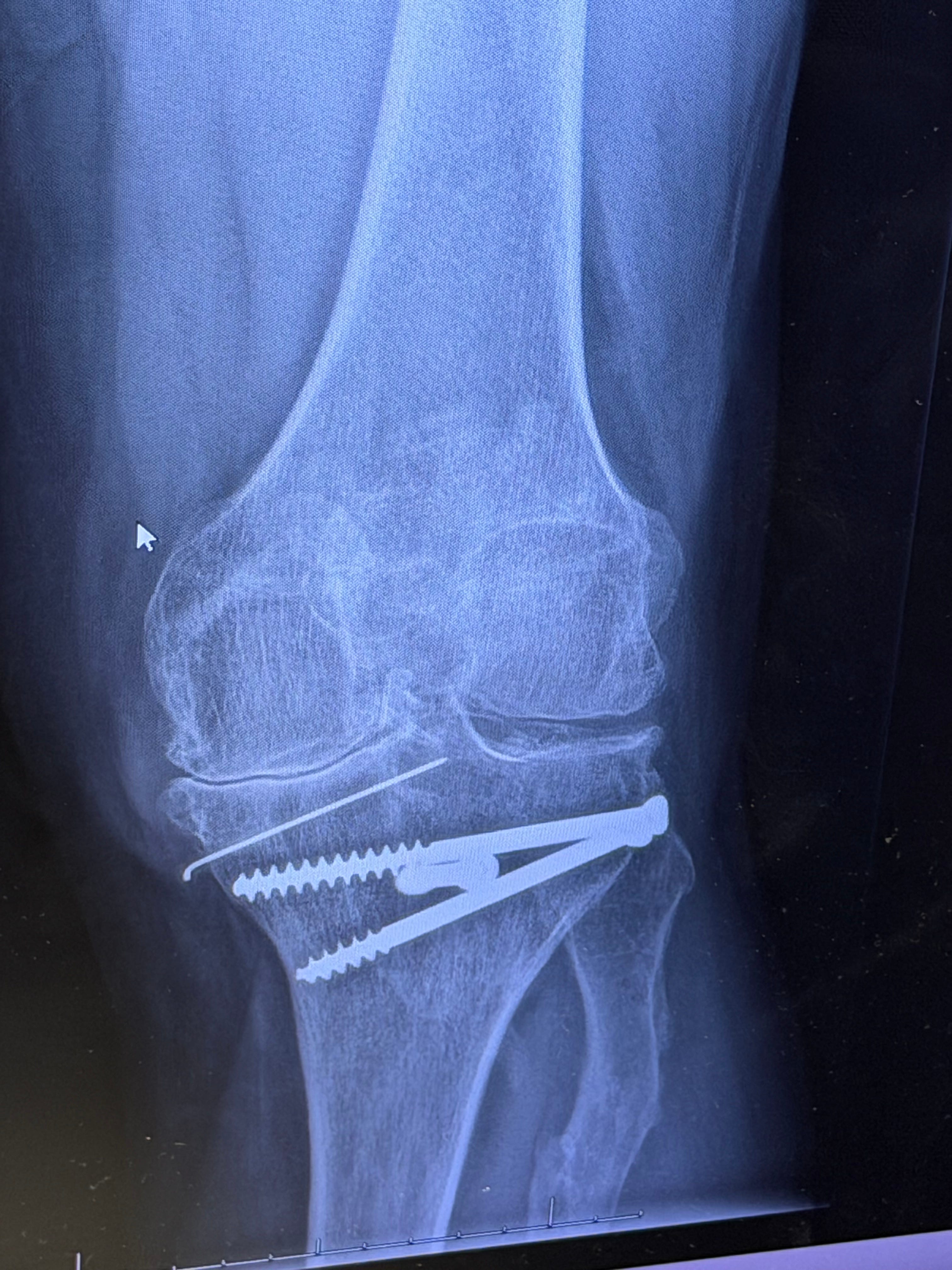
So, I’ve been going to different orthos as I’ve moved around the country. Here’s what the knee looks like now. It’s bone-on-bone. When orthos look at it now, they say, “it’s bad, come back when you can’t walk.” You can see the screws and pins from the big night, and also, that the fibula broke and there was so much else going on, that they didn’t do anything to fix it.
Avoiding the replacement
This summer, I thought the time for the surgery had arrived. I was struggling to get in and out of cars, I wore the off-loader brace all the time, and I had two incidents where it went out completely for 30 min (both times, I was far from home). Fortunately, I was on a group chat that included the New York Times medicine columnist Rachael Bedard. One day when we were chatting about GLP-1 agonists, I said I was wondering if I should take one to lose weight and maybe buy more time on my knee replacement, but I wasn’t sure if I was overweight enough for it to make a difference (my BMI then was 27). She told me to DM her right away.
Rachael explained that it wasn’t just the weight loss, but that there was an additional effect of the GLP-1 on osteoarthritis (she called it “anti-inflammatory”). She showed me a couple of studies that were done in folks much heavier than I was but where the improvement in the knee was larger than would have been expected just from the weight loss. She suggested the lowest dose of Zepbound might give me significant relief and she had seen that in many of her patients. When I went to my primary care physician, he hadn’t heard of the study but gave me the prescription.
So I started 2.5 mg Zepbound. The effect on my knee was almost immediate. I stopped noticing it or thinking I needed my brace. I started getting in and out of cars with no trouble. I can still feel it carrying things up stairs but it’s completely transient. I have lost around 11 lbs and my BMI is 25 now, but that isn’t a ton of weight, and the knee relief started before I lost any weight. My doctor agreed I could just stay on the lowest dose as long as the knee feels good.
The science catches up
Last week, the New England Journal of Medicine published another study that has been widely covered in the media. And scientists have even started working on the mechanism of how it works beyond just the weight loss in studies here and here. One important feature in the latest NEJM study is that the effect was observed across the doses studied. This is consistent with the fact that I’m observing it at the lowest dose and that it started before I lost any weight. And unlike most of the people in these studies, my arthritis was caused by a traumatic injury rather than developing over time.
Forty-two years ago, a resident told me I’d need a knee replacement in 15 years. I’ve spent all this time figuring out how to put it off. This summer, I thought I’d finally run out of time. Now, thanks to a drug invented for an entirely different reason, I’m wondering whether I’ve bought myself another 15 years.
I’ve certainly bought some time. I’ll keep you posted.
The relief starting before any weight came off fits the idea of an effect beyond load. One thing worth watching: in trial body-composition substudies, roughly a quarter to two-fifths of the weight lost on GLP-1 drugs was lean mass, and quadriceps weakness is linked to a higher risk of symptomatic knee osteoarthritis. For a knee you want to keep another 15 years, pairing the drug with strength work may protect the gain.
Or! Go ahead and get it done now so that you are rehabbing the replacement at a younger age and not stressing your hip or other knee accommodating the one with the worn meniscus cartilage