


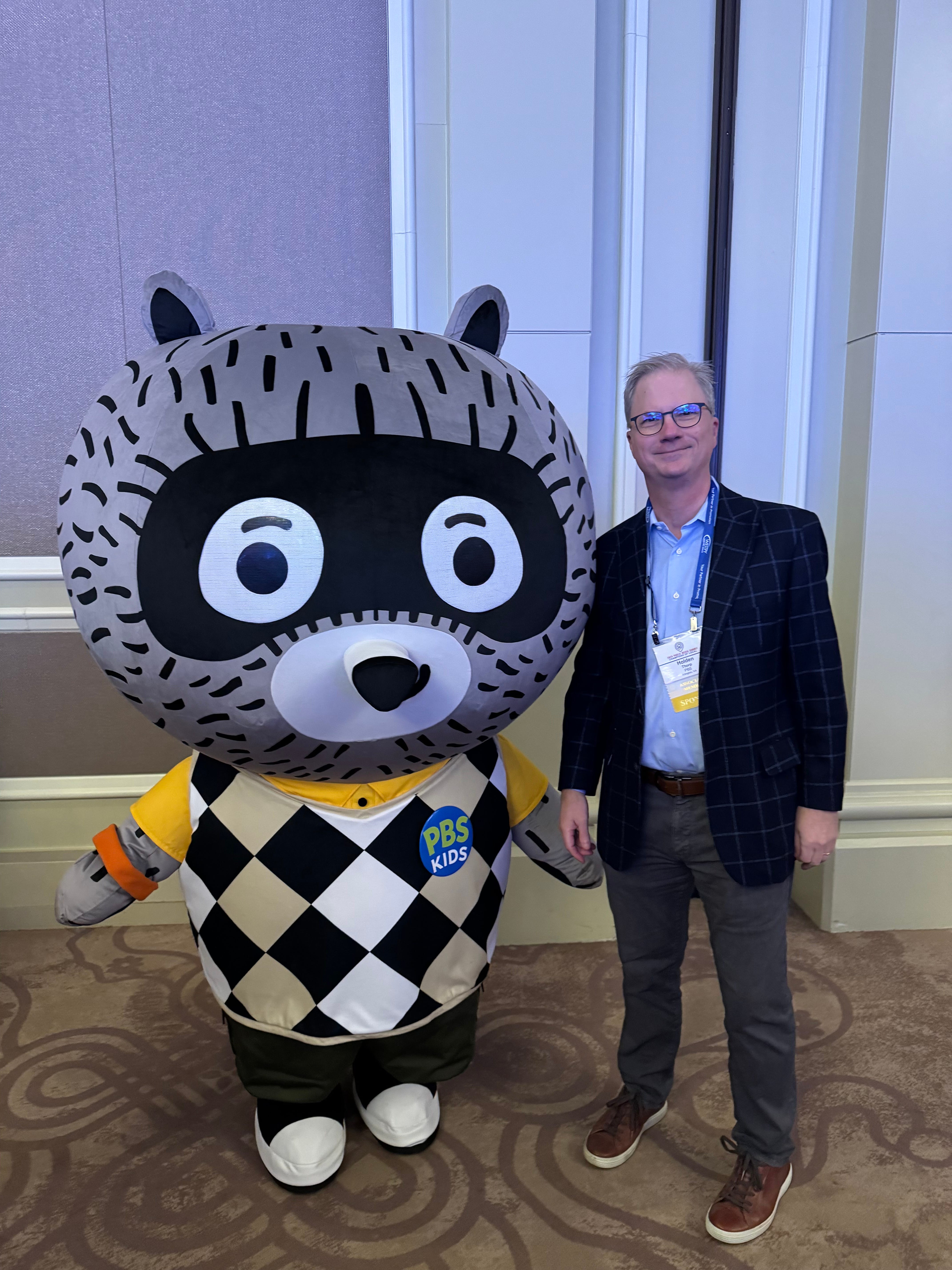
As everyone who reads here knows, I’m very proud to be associated with PBS Kids and especially with the show Carl the Collector created by Zach OHora and the folks at Fuzzytown. What’s great about Carl is that it’s a show about autistic people making friends with neurotypical kids and other neurodivergent kids across the spectrum.
Carl has a profile very consistent with mine: we’re both verbal and don’t have an intellectual disability, but we like to collect things and often miss nonverbal cues completely. Carl has plenty of challenges, but he can run off with his friends and do stuff. One thing that makes life a lot easier for him is that his neurotypical friends understand him and work to accept him, while he works to understand how his autistic traits affect them. Those interactions are the crux of the show and so important as the world accepts neurodiversity.
Carl also has an autistic friend, Lotta, who has sensory sensitivities. Unlike, Carl, she chooses to keep her autism private from the neurotypical friends, which is consistent with the barriers that women and girls sometimes face on disclosure. But like Carl, she is verbal and can run around with the other kids in Fuzzytown.
Carl has one other autistic friend, namely me, but so far, I haven’t been cast on the show.
In working to better represent everyone on the spectrum, this week Carl got yet another friend who needs more support than he and Lotta do. Paolo is a non-speaking character who uses an iPad to communicate, and his parents are generally around when we see Paolo. Here’s the episode.
Like another non-speaking autistic person that I discussed on here, Hari Srinvavasan, Paolo is not completely silent. So for the sounds that he does use to communicate, the creators found a non-speaking autistic person named Odin Frost to provide the voice. Odin’s family does a lot for autism awareness at the Instagram feed @allthingsfrost. Here’s an awesome video of Odin working on Carl:
There are autistic people who need even more support than Odin and Paolo, and for sure, Odin has other challenges that we don’t see here. But getting someone like him and a character like Paolo into Carl the Collector is a great step forward.
While this pushes things about as far as you can in a show for children, there is a Pixar short that shows an autistic character who is also non-verbal like Paolo but is shown having more difficulties. This short does an excellent job representing the non-speaking part of the spectrum:
As I’ve been interviewing people for my book, I’ve found a lot more agreement about how we should think and talk about autism within the autism community than gets represented in the press. Getting these characters with higher support needs into programs for children will go a long way towards bringing everyone together in a way that is desperately needed.
Thanks for publicizing this development in media programming. I like seeing diversity represented in what people see and hear. I'm a little wary, however, about whether such programming will actually influence appreciation of diversity, perception...well...anything.
"Getting these characters with higher support needs into programs for children will go a long way towards bringing everyone together." Is that so? Will the behavior of members of the general public change in some way that we can observe?
In schools there have efforts at least since the 1980s to promote awareness and even appreciation of disabilities. There is no shortage of activities, lesson plans, and even "programs" or "curricula." When those efforts are examined scientifically, however, the outcomes are what I would characterize as less-than-inspiring. When studies (including integrative literature reviews and meta-analyses) report beneficial outcomes, they are usually improvements in people's expressions of agreement with statements (strongly agree...strongly disagree) or other self-reported attitudes. There's little about objective change in behavior.
Take away: Inclusion of characters with severe autism in media may make us feel good, but I hope readers don't get their hopes up for changes in how people with disabilities are treated.